If you feel a news story does not measure up to expected journalistic standards, bring it to the Journalism Dry Cleaner. Through our collective wisdom, we will strip it of all offensive dirt.

REAL TIME VISITORS

LIVE STATS

BLOG GUESTS

Wednesday, 25 April 2018

ADVERTORIAL CONTENT AND LANGUAGE EXPERIMENTS

Language is supposed to be dynamic. The aim is to ensure every possible aspect of humanity can be coded in a form that can be meaningfully expressed, either through native or borrowed words. But this flexibility is not permission to violate language structures, especially in formal communication. Editorial and advertorial content should not contain language experiments.


Sure, it's good to be unique, but I'm not sure the media can push the creativity boundary beyond the realm of making grammatical sense.

After all, the central aim of a newspaper is to provide readers with information that is packaged in a way that directly communicates the intended meaning, or at least provides adequate context for relevant interpretation of the information being conveyed.


There's leeway for the one crafting the headline to play around with words in order to come up with captivating headings.

But the language of poetry might not always work, when deployed in a newspaper article.

Moreover, as it has been argued here on several occasions, a newspaper should not distance itself from the errors contained in advertisements, supplements or even externally produced inserts that form part of the publication.


In my view, everything published in a newspaper ought to have first passed through the usual editorial process.

To believe otherwise is to invite language experiments, and other forms of editorial or advertorial misadventures.


Thursday, 19 April 2018

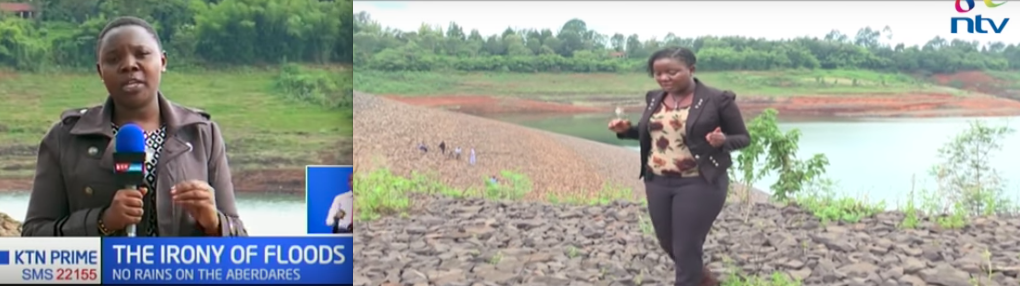
LAZY JOURNALISM, ENTERPRISE REPORTING AND AN EMPTY DAM

It's the middle of the wettest season in Kenya. Then comes a very curious coverage highlighting the strange fact that the dam that supplies the capital, Nairobi, is close to being empty. Lazy journalism gets satisfied with the official explanation. Enterprise reporting digs deeper to unearth facts that either independently affirm or discredit a story.


Instead of local media just dwelling on this 'supposed' oddity, seeking more evidence to explain this hard to believe reality would have been more impactful.

Weather reports from the meteorological department have of late been remarkably accurate.

So, their records would easily help ascertain the veracity of claims that there has not been sufficient rainfall around the Aberdare Mountain Ranges, which is the catchment area for the Ndakaini dam.


Instead, the authority being relied on here is an official of a water company that supplies water to Nairobi.

Moreover, the media could also go beyond the confines of the press junket and visit the areas lying further upstream, and if necessary, go up the Aberdares, to establish if indeed rainfall is that scarce.

There was a time I wanted viewers to understand the concept of a 'water tower' and had the privilege of going up the Aberdares, on the Nyeri side.


My observation was that the rainfall up the mountain is almost self-generated, thanks to the massive transpiration from the forest, which somehow makes it look like clouds are rising from the trees below.

In essence then, the rainfall up this mountain could be more dependent on the tree cover, than whether or not there's drought or it's the rainy season, which could also explains why there are so many permanent rivers emanating from the Aberdares.

Another time,  when I was assigned to do a TV news story about the low water levels at Kenya's main hydro-electricity generating dam, I ventured further upstream.

I did establish that the rivers in the region were at that time drying up, probably due to global warming, but something else also became quite evident.

There was water abstraction on a grand scale from the rivers leading to Masinga dam, by mostly farmers upstream, and also through numerous water supply channels to the surrounding communities.


If the local media can afford to deploy reporters to far- flung countries such as Australia, it wouldn't be that impossible to widen the scope of their coverage within Kenya's borders.

And please remember that lazy journalism ends where enterprise reporting begins!


Thursday, 12 April 2018

FROGS, FACTS, FALLACIES AND FAKE NEWS

Reliable and credible news ought to be anchored on solid facts. And the press simply should not convey information. Value addition through interpretative or analytical processing is the now the accepted standard. But if this is not carefully done, the audience may end up being served with frogs, half baked facts, marinated fallacies and steamed fake news.


Whereas the screaming headline above grabs deep attention by suggesting hundreds of thousands of young people are not interested in getting their college education funded by the Kenyan government, it could be quite shallow in substance.

The state, would most likely finance the studies of students enrolling in either degree, diploma or certificate courses.

Out of  the over 600,000 who sat for the 2017 secondary school leaving exam:

- slightly over 69,000 attained grade C+ and above, the minimum university entry requirement

- about 100,000 got between grade C and C- , and these qualify for diploma and certificate courses.

- while over 350, 000 candidates scored between D and E, that makes them eligible for mostly craftsmanship and artisan courses.


This would be a good place to start looking for the 'rumoured' 500,000 who supposedly 'snubbed free college education'.

And while at it, bear in mind that the entire annual capacity for state-sponsored degree, diploma and certificate courses can only accommodate about 210,000 students.

Incidentally, not everybody who applied for financing from the Higher Education Loans Board in the past has been getting it, or the entire amount required, so it will take a lot of convincing to believe that the government is in a position to fund post-secondary education for all the 2017 candidates.

The state, most likely, would realistically be more worried by the nearly 6,000 qualified candidates who failed to secure university placement this year, due to inadequate cluster subject scores for their chosen courses, or the fact that they did not apply at all.

The fixation by a section of the local media with the figure of 500,000, is apparently then not as warranted, as the picture being painted.


Now what is left is the small matter of frogs.

Anyone out there who can croak a believable explanation?


Thursday, 5 April 2018

FIGURATIVE WHIP AND LITERAL WHIPPING

Information is most effective if its shared in a way that directly makes sense to the intended audience. That's why the media ought to communicate in a clear and simple manner. If the words deployed in an article are ambiguous, it could lead to an unintended interpretation. Whipping figuratively could conjure images of weeping, after a literal whipping.


That's why the use of jargon is especially discouraged, where the context is not immediately familiar to everyone.

For those aware of parliamentary procedures, the headline above makes no allusion to legislators being 'flogged' so as to follow a particular political inclination.

There could, however, be a group of 'clueless' readers, who would proudly profess their ignorance on matters politics or the conduct of parliamentary business.

Indeed, someone could have been made to believe that Kenya's former Prime minister assaulted Members of Parliament using a whip, to dissuade them from abandoning a political line.

But the whip needs to be cracked on ambiguous headlines!

Friday, 30 March 2018

ADVERTISING CONTENT CRYING FOR EDITORIAL CONTROL

In many Kenyan media outlets, the relationship between the newsroom and the sales or advertising department is either pretentiously rosy, or downright hostile. The management knows these two teams must co-exist, if the organisation is to stay afloat. Profit often takes precedence over public interest. Editorial control ought to also be exerted over advertising content.


The input of a copy editor is invaluable in ensuring news content is primed for publication or broadcasting, devoid of factual or grammatical errors.

In the above piece of advertising in a local daily, a second eye would have probably spotted the mistake.

Indeed, if the mandate of a revise editor was to be extended to the advertising copy, many ignominious blunders would be eliminated before they are a sniff way from getting published.


But there is just one small problem with the prescribed solution.

Even in their core duty of cleaning up journalistic content, copy/revise editors have been known to fail miserably.


How safe then is advertising content, if placed under editorial control?

It's easy to conclude the terror of errors, in the press, will continue to depress us.


Wednesday, 21 March 2018

EPISODIC NEWS COVERAGE AND MISSING THE BIG PICTURE

News has moved from cycles of 24hours for newspapers, hourly for radio and TV, around the clock on websites and even 69 seconds a minute on social media. Traditional news outlets have all but lost the battle of breaking news. But providing context and analysis remains a bastion of legacy media. Episodic news coverage, however, helps the audience to miss the big picture.


After heavy rains pounded many parts of Kenya, local dailies narrowed on a particular area that had developed huge cracks across a busy highway, with the fault lines extending for quite some distance.

Initially, the reportage was anchored on what officials in charge of road construction and maintenance had to say, and efforts to ensure urgent repairs allowed the traffic to move again.

But days earlier, one of the dailies had a story about a community worried about repeated tremors, not so far from where the ground appeared later to be opening up.


Yet there was no indication that the views of an expert were sought, or a corroboration of the reported seismic activity with relevant geological data.

Thereafter, TV news channels trained their focus on the unusual fissures that emerged after the heavy downpour.

And now perhaps sensing there could be a more 'juicier' story, there was suddenly talk of Kenya splitting, an tectonic plates shifting.


To underpin the supposed seriousness of this 'newfound' issue, the story got a page one treatment, and this time, lots of experts were captured in the article.

The latest instalment of this episodic coverage is a an editorial.


All these elements appear to be connected:

- the tremors,

- the heavy rains,

- the emerging fault lines

- even the country splitting

- and the possibility of Kenya finding itself in another new continent, detached from mainland Africa, with other neighbouring countries.

But the information shared by the media did not adequately equip the audience to make sense of these related developments, in my opinion.

Let's see where the next episode takes us.


Thursday, 15 March 2018

BRAIN SURGERY SHOCK: FROM MEDICS TO MEDIA MIX-UP

It's been described as the biggest medical mix-up in Kenya. A patient in no need of brain surgery had the procedure conducted on him, at the country's largest referral hospital. The cause of the confusion is being attributed to two patients being wrongly labelled. Apparently, it's just not medics who mess up name tags. 


The fallout from this harrowing medical error has been closely followed by the media.

And yet in seeking to help the audience understand the circumstances that led to this monumental mistake, a section of the media inadvertently demonstrated just how 'easy' it can be to mix-up people's names.

According to this TV news report, Dr. Malachi Odhiambo, is an anaesthetist at the Kenyatta National Hospital.


But are we referring to this Dr. Malachi Odhiambo?


Or maybe this one?


No, wait...the above could as well be the real Dr. Malachi Odhiambo.

Clearly, editorial desk errors, do not even come close to errors in judgement, on the operating table.

The media though, operates on the premise that facts are sacred.

And getting people's names and titles right is among the most basic of required journalistic rigour.

So too, is correcting editorial mistakes.

It's unacceptable that this one error appeared on screen on two different days, across three bulletins!