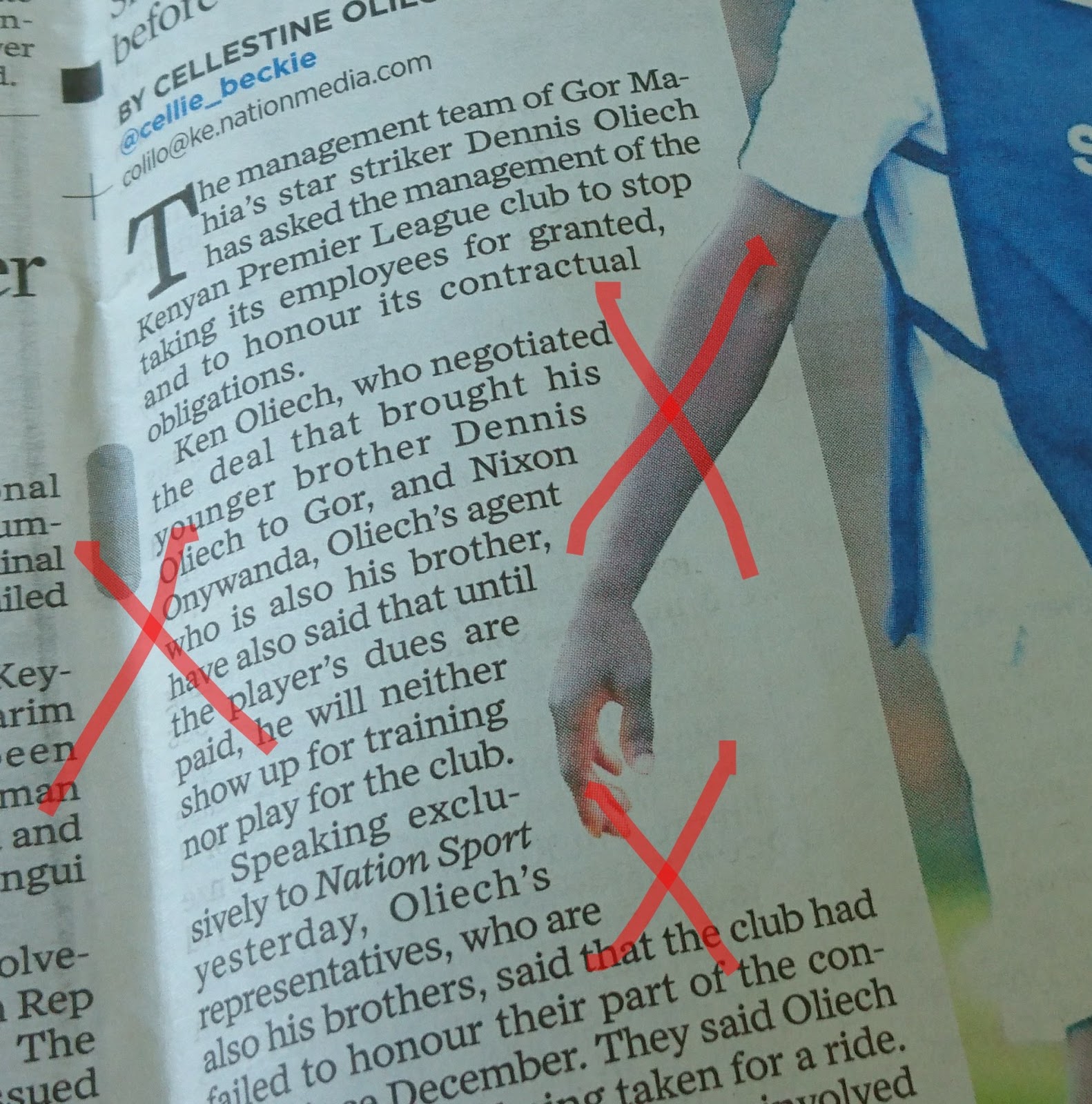
A newspaper's editorial space stands out from the rest of the publication. It is where the paper expresses its position on topical issues. And for very good reason, therefore, not just any staff member can craft this highly regarded article. That's why it's so shocking for a newspaper to allow a poorly written article to occupy its editorial page.
And poorly written, in this case, is not in terms of how the article has been laid out, or even grammatical inadequacies.
It is an alarming congruence of inaccuracies and fallacies.
A stupefying display of ignorance and detachment from historical facts.
And a shameful portrayal of journalistic flaws.
The articles seeks to rally one of Kenya's most successful football club, to achieve even more success in an Africa cup competition, after registering successive losses.
These are the main highlights of the article about Gor Mahia:
- 4.0 humiliation at the hands of Egypt's Zamaleck
-during the CAF Confederation Cup quarter finals
-when Algeria's NA Hussein comes calling
- they are the only team in the country to have won the continental tournament then known as CECAFA in 1987
- Thirty years is a long wait
How is it possible for the editor not to know that the Egyptian team is Zamalek, the tournament is still in the group stage not quarter finals, Gor has already played the Algerian team at home, and the next opponent is Angolan side Petro Atletico de Luanda?
The most horrifying misinformation is that Gor is the only team in Kenya to have won a continental tournament, then known as CECAFA in 1987.
How does one even begin to confuse a continental tournament with a regional one?
Even the said long wait from 1987 to 2019 is certainly not 30 years.
And that is how not to go about editorial writing, my not so learned editor!
An uncompromising critique of how the media covers topical issues, challenging traditional journalism concepts and charting fresh interpretations of news.
If you feel a news story does not measure up to expected journalistic standards, bring it to the Journalism Dry Cleaner. Through our collective wisdom, we will strip it of all offensive dirt.
REAL TIME VISITORS
BLOG GUESTS
Friday, 15 March 2019
Friday, 8 March 2019
MEDIA CONFUSION, THERAPY AND PHYSIOTHERAPY
One of the core function of the media is to inform, enlighten or educate. But sometimes, an encounter with the editorial content in Kenyan outlets, can leave you none the wiser. The risk of being confused is so high, you couldn't know whether you need therapy or physiotherapy.
The newspaper article above is about a group of teachers, affected by alcoholism, completing a rehabilitation program.
But then then the horrendous first paragraph alludes to the odd fact that the teachers:
"...were enrolled for physiotherapy."
How?...Why?....Because who said?
To further compound this puzzlement, there's mention of psychiatrists being involved in the rehabilitation process.
In other words, professional psychiatrists, (do we have amateur ones?), were providing physiotherapy services, to recovering alcoholics.
In the public's interest, the media may need some editorial rehabilitation, from this kind of ignorance.
Friday, 1 March 2019
OH BROTHER! WE GET IT...THEY ARE BROTHERS
Newspaper articles use different approaches to first grab a reader's attention, then sustain it with useful or information or interesting details. Repetition of information is frowned upon, not unless its necessary to emphasise a point. But a reader need not be reminded that brothers are brothers.
At first mention, there's no harm in stating that the key subjects in this particular story are related.
For what it's worth, the writer should perhaps not be heavily faulted for establishing who is the younger or elder brother of the central figure in the story.
But to shortly afterwards re-state that the younger, elder, and key person in the story are brothers, is pushing it too far.
Oh brother! We get it, they are brothers.
Friday, 22 February 2019
TV NEWS, LITTERED SCREEN AND IRRELEVANT INFORMATION
A viewer of a TV news broadcast expects certain elements. Video or moving images is a basic expectation. And so is sound or an audio component. Pictures, whether still or animated, are also acceptable. Alternative visual aids like maps and other graphic presentations help to illustrate stories. But the screen should not be littered with additions that don't add value to the viewing experience.
In the example above, there are some graphical details that have nothing to do with the story on air.
Imagine visiting a website, only to encounter the back-end...with all the coding 'gibberish'?
That information could be mighty useful to the webmaster or coder, but to a user on the site, it's unsightly and on the extreme end of the useless scale.
The same applies to tuning in to a news channel, only to be met with irrelevant information like 'video converter'.
Again, it could be a technical error.
But yet again....there ought to be editorial mechanisms of minimising the impact of the resultant visual terror.
Friday, 15 February 2019
OF THUMPING, THUMBS UP AND A RAPID RESPONSE EDITORIAL UNIT
A Rapid Response Editorial Unit would be a welcome addition to newsrooms, to be always ready for deployment, especially during a live TV news broadcast. The job description will mainly involve swiftly correcting mistakes that find their way to the on air content. Erroneous TV graphics should not just attract a thumping, but a thumbs up for a quick recovery.
Before a budget line is availed for the rapid response editorial unit, all that is needed is a high sense of alertness for the news production crew, as illustrated above.
How long did it take to amend the typos?
Less than a minute!
Ladies and gentlemen, boys and girls, parrots and parakeets...it is very much possible to transcend editorial embarrassments, and get a thumbs up, instead of a thumping from media critics.
Friday, 8 February 2019
TV GRAPHICS: TO ERR AND TO AMEND ERRORS IS HUMAN
To err is human. But so is to amend errors. This is what minders of on air TV graphics should constantly be reminded. And this courtesy should be extended to other personnel involved in the production of a news broadcast. Sometimes the mistake is so glaring, yet the editorial crew is just staring at a visual aid cue.
In the sport story above, the fixtures for that particular weekend's club football in Kenya, are straight-forward and easy to follow.
But the lower third tag blatantly renames one of the teams involved.
In the newsroom, the habit of doing a spell-check for all scripts is greatly encouraged.
Ironically though, such a highly desirable standard operating procedure could perhaps have yielded the graphical blunder.
It's strange though, that Mathare Utd could transform into Mother United, but Vihiga Utd cannot become Vicar United!
Friday, 1 February 2019
TV NEWS AESTHETICS AND A FACE ON THE KNEES
Television is a visual medium. The eyes are fully engaged, while the ears take in the audio component of the content. Besides the science of how a broadcast is perceived, there are also artistic elements in the presentation that enrich the viewing experience. But any major deviation from what the natural expectation is, can be problematic. Like a face on the knees.
The studio set designer above, probably thought everything checked out, in positioning the news presenter on the side, to allow for a large video wall space, for contextualising the specific news about to go on air.
And looked at with the naked eye in the studio, the set-up probably meets all the required standards.
However, graphically inserting another video of the translator, and positioning it on the bigger image captured by the camera, could bring in some unintended consequences.
Here, the viewer is being asked to accept that it's natural to have a news presenter standing, with the sign language interpreter fixed somewhere on her knee region, and her legs appearing to be joined with the upper body of the interpreter.
These kind of visual distractions undermine a viewer's focus on the substance of the news content.
It's not easy on the eye and it's hard to mentally process the creative miscue.
Subscribe to:
Posts (Atom)