If you feel a news story does not measure up to expected journalistic standards, bring it to the Journalism Dry Cleaner. Through our collective wisdom, we will strip it of all offensive dirt.

REAL TIME VISITORS

LIVE STATS

BLOG GUESTS

Showing posts with label The Standard. Show all posts

Monday, 20 January 2020

FACTS, FICTION AND FANTASY NEWS

The world of make belief works best in the movies business. Truth might sometimes be stranger than fiction, but facts remain the bedrock of true journalism. There is fantasy football, but there can never be fantasy news. That's why foolishly unbelievable newspaper accounts are so irksome.


It's almost impossible to explain why the editor elected to dwell in impossibilities, in crafting the article above.

Immediately after the headline, a reader encounters a strange bit of information stating:
Education ministry extends the deadline for Form One admission  to January 17.
Have you noted the absurdity yet?

I've given you a clue already. And it has all to do with the date of publication for this particular paper.

At the far-right corner...the date reads 19th January! And the deadline extension being suggested...up to 17th January.


The 'clueless' editor couldn't care less that the right information is well captured in the main article.

The reader would certainly care more if editorial judgement is not easily compromised.

Saturday, 23 November 2019

FACTUAL INFORMATION AND A FICTIONAL NEWS SENSE/TENSE

That the truth can be stranger than fiction is hardly disputable. And fictional accounts in the mainstream media have their own special sections, where the truth is not a key consideration. But when reporting the news, the press has to be accountable for the shared facts. It is strange to come across content that's based on factual information, yet ends up looking fictional.


That's what's apparent in the article above, and it has all to do with the conveyed sense, from the headline.

Let's try and break it down. The editor saw it fit to call attention to the story by stating:
'3 in priest murder case plead later'
So, did the suspects take the plea?

Not really, contrary to the insinuation from the headline.

And what is actually meant by 'plead later' and is that even a possibility?

Plead suggests the action already happened, so to assign it a future time frame, is nothing short of an absurdity.

It's most likely the editor intended to say the suspects would 'plead later' but perhaps due to space constraints, ended up omitting the one innocuous word that would have made all the difference.

'3 in priest murder case TO plead later'

Yes. This even tallies with the details in the story because the suspects didn't take plea.

Please editor, heed my plea and plead guilty for this editorial offence.

Saturday, 16 November 2019

WHEN SAME INFORMATION TAKES DIFFERENT FORMS

Kenya's mainstream newspapers are known to strive to differentiate their content, in a bid to retain their respective audiences. However, even publishers know that in the news business, there's little that can be done to render facts in one story differently. It's therefore quite odd to see the same information take different forms. The angles can differ but not the truth.


In the coverage of the story above, it appears like either one paper did not have it's facts right, or the other was being economical with the truth.

What is the title of the main subject in the story?

Paper 1 alludes to the fact that the Nairobi County Assembly Majority Leader is embattled but still in office.

Paper 2 though, refers to the same majority leader as having been ousted.

If one has not been following the going ons at the Nairobi County Assembly, this indeed could be quite confusing, and frustrating.

But for one who's familiar with recent developments of the same assembly, it would be very apparent that the main subject of this story is no longer holding his previous position.


And that then raises the question of why one simple fact can yield two interpretations.

Or, is this a credible editorial omission, or a commission of a discreditable edit?

Thursday, 15 August 2019

KENYAN ROOTS, JAMAICAN SINGER, AND A NON-EXISTENT SONG

Doing a background check before writing a news story, should be an easy task. Supporting facts can now be sourced conveniently in this digital age, where the Internet is a living and ever-growing library. That's why it's hardly believable that a Kenyan newspaper can't distinguish between a song, and a son of a famous Jamaican singer.


In the article above, the writer tries to enrich and provide a wider context in the recent visit to Jamaica by the Kenyan president.

The coverage is woven around the historical struggle for freedom from colonialism by the East African nation, and the influence of independence proponents from the Caribbean island.

And no reference to Jamaica is complete without mentioning its pulsating reggae industry, which is relevantly captured in this article, given how its global music icons have been committed to the struggle against social, economic and political injustices.


Evidently, a lot of research went into piecing together this newspaper story, so it's a bit mind-boggling why the writer and sub-editor would mess up on the details around the life and music of such a recognised music legend like Bob Marley.

I'm not entirely sure if there's a linguistic connection between the name, 'Kimani' from Central Kenya, and the 'Kymani' with Jamaican roots.

But what I know, and what the writer and editor of the article ought to be aware of, is that Ky-mani is Bob Marley's son, not one of the songs from his impressive repertoire.

Please beware, an enlightened reader is not ready to sell their intelligence for a song!


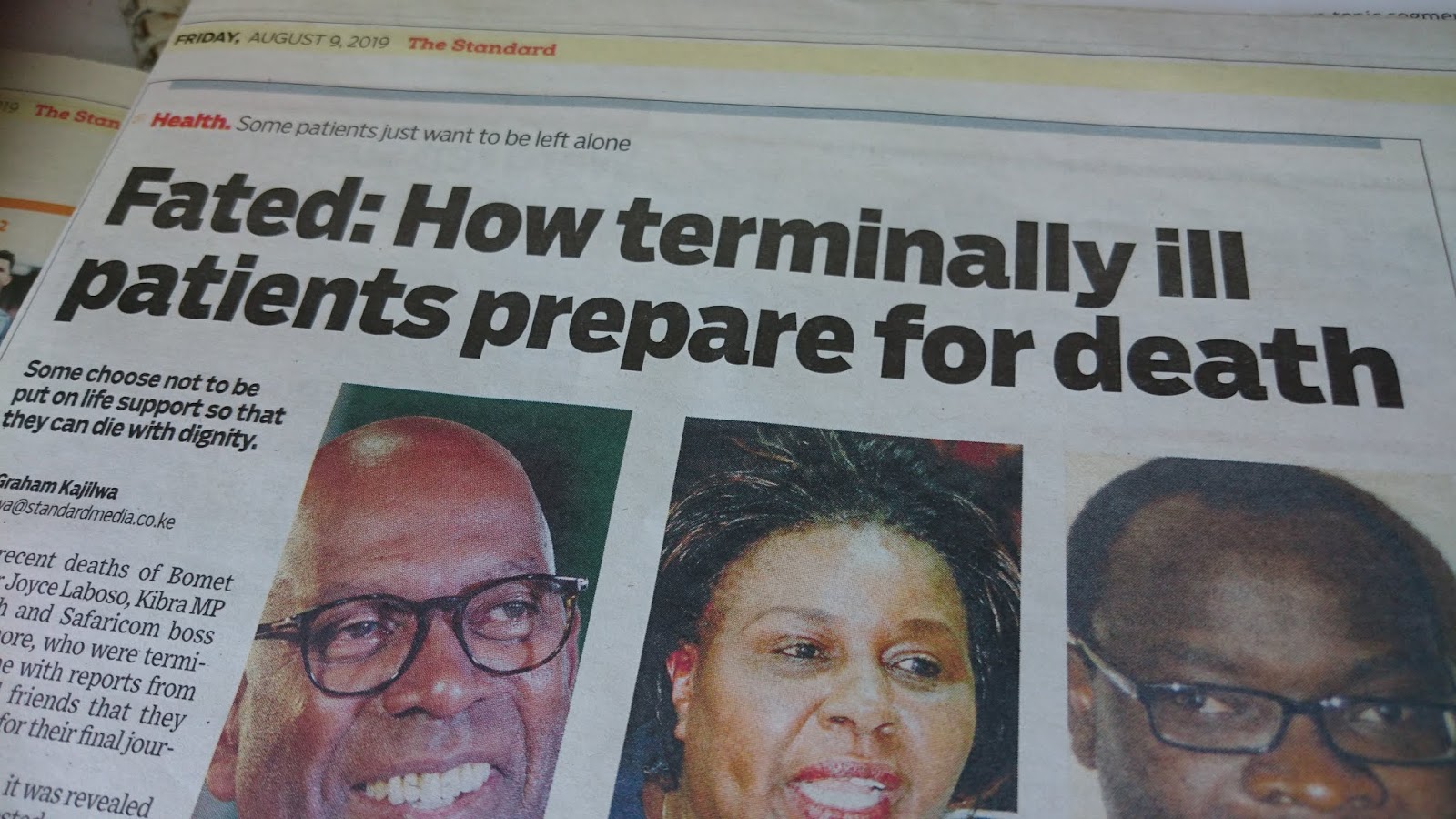
Friday, 9 August 2019

OF HEADLINES AND HEAD SPIN-INDUCING CONTENT

The language used by the press should communicate or convey information in a very direct and comprehensible manner. This means editors, reporters and writers must deliberately align their choice of words with the main aim of making it easy for the reader to understand a story. Sometimes though, one encounters headlines with head spin-inducing content. 


In the front-page teaser of a main article above, the paper deploys a rather confusing or, shall we say, unusual sentence construction.

It starts with:
'How fatally ill patients...'
That means patients who have already succumbed to their illness, no?

And if that be the case, then the second part of this headline gets eerily weird.
'....get set for death'.
Cue the head spin!

Fatal conveys a sense of finality or culminating in demise, or a not so pleasant fate.

So fatally ill patients, one would expect, are not in a position to do pretty much anything, because the illness has already resulted in fatality.


There are those on the verge of dying, that this newspaper story seeks to highlight their final moments and decisions.

This time around, the headline of the main article makes reference to, 'terminally ill patients', which gives room to suggest they can still do something, ahead of their sunset moment.


Saturday, 8 June 2019

FROM MEDIA MONOTONY TO MEDIA MORONITY

The content across Kenyan media outlets can be very monotonous. You tune in to one news channel, and most likely stay there, because if you see one, it's like you've seen all of them. But nothing shouts lazy journalism more than when one publisher regurgitates what another has already put out. That's when media monotony morphs to media moronity.


The story of how Kenyan cars are registered using differentiated number plates makes quite a fascinating reading.

But, does it mean other media outlets should just copy what has already been published?


New angles can be used to add value to the original content, and still make the replicated read relevant.


You get a sense that this was not the intention here, because someone even decided to use the same photograph to illustrate the lifted story.

The take home lesson?

The biggest fan of a Kenyan media house...is a rival media house!

Saturday, 25 May 2019

LYING & MEDIA LAYING DIFFERENT VERSIONS OF SAME TRUTH

There ought to be a semblance of factual unity in the information a media outlet is pushing out. And if accounts of the 'truth' are in conflict, then a balance in coverage is essential. However, the media consumer should not be left with different versions of the same truth. Somewhere therein lays some lies.


In the above newspaper publication, the reader is confronted with contradicting interpretations of what is seemingly one policy from the Kenyan government.

One article in the newspaper states that the government will not relent on implementing a supposed ban on the importation of some used care spare parts.

Here, the relevant government agency is said to have started enforcing the ban.

A number of pages, later on in the same newspaper, the very same standards agency is quoted denying its enforcing a new directive seeking to ban importation of car spare parts.

Whether the two articles are differing on whether it's a new or old statute, is besides the point.

And neither is it of much significant consequence here, if the said ban targets all or some car spare parts imports.

The concern here is the failure by the newspaper publishers to provide a common context for these two related articles.

In a reader's mind, this media outlet could be laying different versions of the same truth.

Who do you think is lying?


Saturday, 4 May 2019

REGGAE, RESEARCH AND MEDIA KNOWLEDGE GAPS

To share knowledge, one has to be in the know. Many media outlets try to appear-all-knowing. Then it all falls apart, when the apparent knowledge gaps gets blatantly exposed. And to think that all it could take to make a big difference, is a little reggae-inspired research.


The writer of this article does well in capturing many facets in the evolution of reggae music.

However, there are a few details that would raise credibility concerns, especially among those familiar with this subject matter, like yours truly.

The ban of reggae music in Kenya was much evident after the 1982 coup attempt, and this is linked to the fact that this is the type of music that was being played on air, before the national broadcaster was secured.

It was also widely being mentioned at the time, that this genre of music glorified and promoted the use of proscribed drugs, (of the Jamaican flavour).

Unlike what is reported in the article, reggae made a comeback in the public broadcaster in the later part of the 1980s.

I still remember how refreshing it was to hear from the radio, Burning Spear chanting down Babylon in Mek We Yadd.

And, the Grammy Award for Reggae started a bit earlier than what the article purports.

Again, I should know, because the first recipient was, and still remains my favourite reggae band, Black Uhuru, in 1985, for their phenomenal album, Anthem.

Granted, the press covers a lot of ground to keep its audience informed.

It could be about current affairs, future events or even past occurrences.

Present events could be hard to process correctly and, well, the future can be unpredictable.

But historical facts should not be that hard to relay, if you know where to dig them up from.

That's the beauty of research in journalism. Details from eons ago can easily be woven into modern-day articles, for depth add contextualisation.

For the umpteenth time, the media should not underestimate the capacity of the audience to discern between facts and fictitious accounts.


Friday, 19 April 2019

SETTING THE STANDARD IN MEDIA MISINFORMATION

In the news business, the information being disseminated ought to be accurate or factual, and essentially, this needs to be verifiable. And in a world of real time digital communication, the media would be ill-advised to assume its audience does not have the capacity to cross-check details of published stories. The standard should be to ruthlessly deal with media misinformation.


Details like where a road begins and ends may seem unimportant in the above article, but that's no justification to deviate from accurate reporting.

If the writer or editor is casual, when it comes to attention to details, there's a very good chance of upsetting an attentive reader.


And there's no telling if some media consumers can be well-versed with such a 'little' matter like the layout or meandering of a road, (hint...hint...ME!)

The article above says:
'The 6.1m kilometre Enterprise Road...stretches from the junction shared with Bunyala Road and Commercial Street...'
That's not where Enterprise Road starts from.

The stated spot has a roundabout, where Bunyala Road, Commercial Street, Workshop Road, and I believe, Dunga Road intersect.


This may be hard to believe, but on the grass growing inside that roundabout, is where some 'epic' intra-estate football matches used to go down...many decades ago!

Yes, the ball would frequently get kicked into the surrounding busy roads. But I guess dodging the traffic to retrieve it, was an inevitable hazard.

Let me now take you to where Enterprise Road actually starts from.

From the 'Roundabout Pitch', wait...it's so unbelievable how a bunch of kids would gallop at full speed in such a small space, and score spectacular 'long-range' goals!


Right, let's take Workshop Road, and then branch off, where Factory Street begins, (why do I feel like I'm going home?).


Further down Factory Street....the side with Kenya Railways staff quarters...just before where that white trailer is parked...the first house on that block.... well, it looks very familiar. But let's move on.

When you reach the first junction on the right, along Factory Street, from the direction we've taken from Workshop Road....taraaaah!


That's where Enterprise Road starts from ladies and gentlemen.

And, very close by is a popular 'Big Shop'


Next to this vibrant social joint, is what used to be called Sanford Road Nursery, where someone you now know, started his formal education from.


Back to Enterprise Road, (which also can be accessed from Commercial Street, being somehow parallel to Factory Street), is indeed, a major artery in Nairobi's industrial area.

And it was such a joy back then, discovering the alphabetical system of naming the roads branching from it, from Addis Ababa, Bamburi, Changamwe, Darkar, Funzi, Gilgil, Homabay, Isiolo, Jirore, Kampala, Likoni, Mogadishu, Nanyuki, Olkalou, Pate, Rangwe, and there's probably a road starting with letter S and T, too.


In so many words and precious memories, the stories covered by the media could be so well-known to a section of the audience, that any misreporting of facts could be excruciatingly painful.

Another equally obnoxious element in the axis of editorial evil, is manufacturing facts, which augments the damage of media misinformation.


The presence of a non-existent sub-county here, indicates an absent-minded sub-editor!


Friday, 5 April 2019

POST-DATED ARTICLE IN A PRE-DATED NEWSPAPER

Journalists are among the few privileged people, who get to witness significant history unfolding, while chronicling news of the day and major events. This requires a logical sequence of covering and publishing stories. That's why it's strange to see an article that bears a post-dated time stamp, being reported in a newspaper bearing an earlier date.

Quite confusing, admittedly.

The highlighted article makes reference to a study published in the June 2019 issue of Cancer Epidemiology Journal.

This could potentially be unsettling to a reader, simply because the article is appearing in a newspaper published in March 2019!

It could be a simplistic interpretation, especially to those well-versed with how scientific publications are done in volumes.

But to an average consumer of media products like me, (and hopefully you), a June 2019 issue of a journal, being quoted in a March 2019 newspaper is unusual, (and creepy).

A quick check online, confirms that the issue being referred to does appear in a June 2019 volume.

(And this post is in April 2019, in case you didn't notice).

The writer of the article should perhaps then have dedicated a short explanatory paragraph, to provide context that would enable any reader to make sense of the apparent dating anomaly.

A post-dated cheque can't work before the stated date. A 'post-dated article' also needs to be checked!


Friday, 29 March 2019

UNIVERSITY INTAKE, STATISTICS FALLACY AND MEDIA LUNACY

The media can report on every subject, as long as it's in the public's interest. And its journalists or news editors, are given the significant task of determining the newsworthiness of a story, interpreting facts, and repackaging them for the audience. But it's hardly safe to conclude that media practitioners have adequate or uniform capacity to discharge this noble duty. Media lunacy especially, can thrive in a statistical fallacy. 


Statistics or stories with a lot of mathematical details can be quite a challenge to many scribes, and once in a while, you can come across 'shocking' interpretation of raw data.

The lead story in the Kenyan daily above, could be an example of how strange stories can 'purportedly' emanate from concrete research.

Admission to local universities, one would like to believe, is strongly based on merit, the limitations by factors such as good facilities or superior teaching staff notwithstanding.


It is therefore a bit perplexing to see university enrolment being directly correlated with variables like population size, in a not so 'meaningful' context.

How can a region having the lowest number of university students recently, be linked with population statistics from 10 years ago?


The processing of information from the same set of data, appears to lead the writer/editor into making very confusing interpretations, like:
'In the six counties, female students make up less than one-tenth of one per cent of the total state-sponsored number of 455, 515.'
What would such convoluted facts really mean to the average reader?

The 'shock' element so desired by the publishers of this article, leaves a lot to be desired!


Friday, 15 March 2019

EDITORIAL WRITING: HOW NOT TO

A newspaper's editorial space stands out from the rest of the publication. It is where the paper expresses its position on topical issues. And for very good reason, therefore, not just any staff member can craft this highly regarded article. That's why it's so shocking for a newspaper to allow a poorly written article to occupy its editorial page.


And poorly written, in this case, is not in terms of how the article has been laid out, or even grammatical inadequacies.

It is an alarming congruence of inaccuracies and fallacies.

A stupefying display of ignorance and detachment from historical facts.

And a shameful portrayal of journalistic flaws.

The articles seeks to rally one of Kenya's most successful football club, to achieve even more success in an Africa cup competition, after registering successive losses.

These are the main highlights of the article about Gor Mahia:

- 4.0 humiliation at the hands of Egypt's Zamaleck

-during the CAF Confederation Cup quarter finals

-when Algeria's NA Hussein comes calling

- they are the only team in the country to have won the continental tournament then known as CECAFA in 1987

- Thirty years is a long wait

How is it possible for the editor not to know that the Egyptian team is Zamalek, the tournament is still in the group stage not quarter finals, Gor has already played the Algerian team at home, and the next opponent is Angolan side Petro Atletico de Luanda?

The most horrifying misinformation is that Gor is the only team in Kenya to have won a continental tournament, then known as CECAFA in 1987.

How does one even begin to confuse a continental tournament with a regional one?

Even the said long wait from 1987 to 2019 is certainly not 30 years.

And that is how not to go about editorial writing, my not so learned editor!


Friday, 8 March 2019

MEDIA CONFUSION, THERAPY AND PHYSIOTHERAPY

One of the core function of the media is to inform, enlighten or educate. But sometimes, an encounter with the editorial content in Kenyan outlets, can leave you none the wiser. The risk of being confused is so high, you couldn't know whether you need therapy or physiotherapy.


The newspaper article above is about a group of teachers, affected by alcoholism, completing a rehabilitation program.

But then then the horrendous first paragraph alludes to the odd fact that the teachers:

"...were enrolled for physiotherapy."

How?...Why?....Because who said?


To further compound this puzzlement, there's mention of psychiatrists being involved in the rehabilitation process.

In other words, professional psychiatrists, (do we have amateur ones?), were providing physiotherapy services, to recovering alcoholics.


In the public's interest, the media may need some editorial rehabilitation, from this kind of ignorance.


Friday, 30 November 2018

NEWS REPORTS, NON-DISPOSABLE FACTORS AND DISPENSABLE FACTS

News reports aim to truthfully convey information in a fair and balanced manner. It may appear like a simple task, but other factors often complicate the processing of facts. The audience is assumed to be in need of protection from harmful news, yet the media presumes the right to know also needs to be protected. Some reports though, need a thorough panel beating.


In the article above, the details in the all-important first paragraph 'correctly' summarise the most important facts of the story.

- A family in a given locality

- Exhumed the body of their son

- Their son had been buried for three years

- They wanted to confirm that he was dead

Every thing checks out in the journalistic manual of packaging news reports, except the last bit.

A reputable newspaper of record in Kenya, wants readers to believe there's logic in seeking to ascertain somebody is really dead, three years after they were buried!

Never mind the story revolves around superstitious beliefs.

Ignore the fact that a legal process is necessary before permission is granted to exhume a body.

Concentrate a bit more on the story being very unusual and deserving of media coverage.

Does one disturbing element hit you from the underworld?

I got two blows from the story...namely... Spooky and Spurious!


Thursday, 18 October 2018

FOLLY OF AN ALL KNOWING AUDIENCE ASSUMPTION

A primary roles of the media is to inform. The audience expects to either learn something useful or be enlightened about somebody or something significant. This does not imply that the average member of the audience is not well-informed. And neither is he or she all-knowing. On first mention of key details, the assumption should therefore never be that the information is obvious.


In the newspaper article above, the reader is likely to be flying rudderless, simply because there's no editorial support to aid in the contexualization of the details, and hence the understanding of the news story.

The intro talks about 'Members of the Country Assembly'...and inconveniently neglects to mention the particular county in question.

If Kenya has 47 counties, how is the reader expected to zero in on the one the editor is referring to?

There are names being thrown around like all the readers are all well-acquainted with the personalities being mentioned.

These may well be public figures, but the paper should not assume they are well-known by the public.


Friday, 12 October 2018

DEAL OR NO SWEETHEART DEAL

The media often enlightens the audience about subjects or issues that were hitherto unfamiliar. Publications that ply their trade in English can be particularly useful to learners of the language. But the lesson can at times be hard to grasp, if it's assumed that the meaning will be apparent to everyone. You can't take heart that the deal will be sweet.


In the above article, reference is made to a 'sweethearts deal' in the headline.

An average reader is likely to be perplexed because 'sweetheart' is a common endearment term, that oozes heavy romantic undertones.

There are two parties in this case alright, but one is an institution...the one that employs teachers in Kenya...and the other is a top representative from the teachers' labour union.

A stranded reader may as well be left wondering what a 'sweetheart deal' is all about in this context.

Well, the paper is correct in the sense that this is an acceptable expression, meaning a sort of favourable agreement.

But it's dead wrong to use search a term, without giving proper contextualisation, to enable the reader to derive the right communicative value from it.

Deal with this doubt sweetheart!

Wednesday, 3 October 2018

MORBID HEADLINE, CHILD MORTALITY AND KILLING HUMANITY

It's been argued that the media's penchant to broadcast or publish negative stories can lead to emotional or psychological trauma on the audience. The sad news may be factual, but does it distort the reality? That could be the case, especially when the media appears to threaten the very existence of society. A morbid headline promoting child mortality is a sure way of killing humanity.


In the above newspaper article, very critical elements of journalism are missing...and that gives the headline quite a chilling effect.

Even a casual glance at that headline, is likely to deliver a guaranteed repulsive reaction.

And that is only if the reader can survive the shock of the unintended repugnant message.

The elementary attributes of a news story missing in this abhorrent headline are CONTEXT, and...well...ATTRIBUTION!

There's a barely there indication that the headline is drawn from a conclusion of a study.

However, in the absence of a direct link of the findings of the study and the article's headline, one is left with little choice than to think the newspaper has no problem with anyone calling on mothers to kill their children.

Moreover, it's only in the first paragraph that one gets to understand the context of the story...that it has to do with children born with disability, and their parents being pressured to kill them.

These reckless omissions by the editor make the headline morbid, and its details sordid!

Tuesday, 11 September 2018

100% VALUE ADDED NEWSPAPER INACCURACY

The cost of living in Kenya, it is now widely feared, might be about to get dangerously close to being unbearable. And the local media has been firmly locked on highlighting this issue, as the country awaits a decision by the president on a critical piece of legislation. But this pressing matter it appears, is now even confounding the press. The result is 100% value added inaccuracy.


After consistently reporting on the merits and demerits of the president assenting to the Finance Bill 2018, it's a bit surprising to see an article in the mainstream media that is seemingly out of touch with the basics of this major story.

This in turn could easily leave the reader as 'confused' as the said newspaper.

To begin with, does anyone have a clue as to what exactly the 'VAT Bill' captured in the above headline is referring to?

There has been widespread coverage of the calls to shield citizens from high fuel prices, courtesy of a 16% Value Added Tax on petroleum products that came into effect at the beginning of September.

Pressure has thus been mounting on the president to assent to the Finance Bill, which has a clause suspending the implementation of the VAT on fuel.


Then suddenly, this article audaciously turns the facts around!

My head is still spinning from this spin-off.


Thursday, 2 August 2018

JOURNALISM, ADJECTIVES & ULTRA-MODERN CRAP!

It's not easy to find media reports that are agreeable with the entire audience. That's why being objective or balanced ranks high in journalism. That way, the audience gets to draw their own conclusion. So why should a newspaper purport to use a universal description of something? Adjectives like 'ultra-modern' could as well be describing crap.


The caption above describes one thing, but the picture seems to show another.

What is actually meant by 'ultra-modern' and is it applicable across the board in terms of perceptions?

In other words, if according to the newspaper something is 'ultra-modern' are readers still allowed to hold a different opinion?

A good journalist tries to avoid such superficial use of generalised adjectives, especially when dealing with hard news.

Such kind of value judgement is suspect!

But you be the judge.

Wednesday, 25 July 2018

MEDIA, MEANING SUBTRACTION AND NONSENSE ADDITION

Interpretative storytelling is the crown of journalism, and many an editor will frown upon stories that merely state obvious facts, or regurgitate what news subjects said or did. But the media sometimes subtracts meaning and adds nonsense, which leaves the audience none the wiser.  


In the above picture caption, it's being suggested that physical well-being is an attribute that's being directly linked with home ownership.

If 'healthy' individuals own some of the depicted houses, is the reader supposed to imagine there is another group of 'unhealthy' individuals in the same settlement scheme that don't own houses like those captured in the photo?

And just how insensitive can that kind of reporting be?

Here, it looks like there's inadequate editorial 'wealth'...

...and that is not healthy!