If you feel a news story does not measure up to expected journalistic standards, bring it to the Journalism Dry Cleaner. Through our collective wisdom, we will strip it of all offensive dirt.

REAL TIME VISITORS

LIVE STATS

BLOG GUESTS

Thursday, 2 October 2014

MEDIA RIGHTING WRONGS AGAINST CHILD RIGHTS THE WRONG WAY

Coverage of children in the media warrants utmost of sensitivity. Their vulnerabilities should not be amplified, while seeking to highlight their plight. That's why it was almost absurd for a Kenyan broadcast station, to deem it fit to have a news item of children demonstrating against a 'rape' case. It's a case of the media righting wrongs against child rights the wrong way.


It's first of all an indictment of a society that cannot protect its own children, leaving the little helpless ones at the mercy of beastly miscreants, who rob them of their innocence, in the vilest of conceivable ill-manner.

The intention of the media may be noble, in covering such debased behaviour by adults, preying on defenceless tots. But even so, care must be taken not to worsen a bad situation.

Aside from the need to get (written) consent from parents or legal guardians, before filming and broadcasting the protest, it's highly likely the children were prompted by adults to participate in a public demonstration.

And the fact that they were demonstrating against sexual assault, means there is a chance this sensitive matter was discussed either amongst the children or with grown-ups.

Such a negative context is surely not the way to impart sexual education to post-toddlers and pre-teens, via the media.

The TV station erred in opting to broadcast the story, without even a care about concealing the identities of the demonstrating children.

Ethics should always apply in coverage of children in the press, especially because their right to privacy is absolute.

Abso-godam-lutely! (sorry).


Tuesday, 23 September 2014

HOW TO RE-INVENT INVENTIONS IN TV NEWS

Media outlets in Kenya like publishing or broadcasting 'wonderful' news. A feel good story helps to reduce the impact from heavy bombardment of negative news. But alas! Local TV news channels can also re-invent known inventions! Behold the 'inventor' of the aeroplane from South Sudan!


Inventors are known to have played a major role in transforming the world and greatly enhancing the quality of life. Take flying for instance, so much convenience has rarely taken to the skies.

It apparently is not common knowledge, however, that the aeroplane was 'successfully' invented in the early years of the 20th century.


If the lower third tag of this TV story is to be believed, the Wright Brothers had nothing to do with the invention of the first airplane flight, right?

Wrong!

The closest that the story comes to an invention, is either the TV station's decision to 're-invent' historical facts, or its spirited attempt to alter the meaning of 'invent' from:

"...to design or create something such as a machine or process that did not exist before."

Now let's drink to that. So, will it be whiskey or whisky?


Yet again, another local TV station felt it was proper to use the two terms interchangeably, when referring to a made in Scotland drink.

Let's toast to media mediocrity!


Tuesday, 16 September 2014

MAU MEDIA AGENDA AND A TRAGIC TRIBAL TRAJECTORY

Long format TV features are gaining popularity in Kenyan broadcast stations. They accord adequate time for reporters to thoroughly interrogate topical issues. This came out in a well executed story on the encroachment of the Mau forest complex. But the coverage was ruined by the subtle media agenda in the Mau, courtesy of a tragic tribal trajectory.


The reporter did well in capturing nearly all the possible angles, and incorporating a multiplicity of views. This element was so exhaustive factored in that the feature ran the risk of losing focus on what it intended to highlight as the key concerns.

But for me, what one interviewee said stood out. He was convinced that it was perfectly in order for members of his community, (read tribe), to lay claim to swathes of the crucial Mau water catchment, given that other communities (tribes) were being 'allowed' by the state to plunder the forest.

The Mau Tragedy can't get more tragic!

If the water tower is destroyed, the serious consequences will not only affect particular communities/tribes. The impact of such a catastrophe will even cross the country's boundaries, and be felt by millions regionally.


And this is why the media needs to be cautious. This issue has already been heavily politicised. It should not be further trivialised by whipping up ethnic undertones.

My observations may be far-fetched. But I got the feeling that the TV station inadvertently perhaps, ended up giving prominence to partisan sentiments, with subtle hints of the editorial slant.

Yes. The media mirrors evils obtaining in the society.

No. The media must not always reflect the rot back to the society and deepen schisms.


Tuesday, 9 September 2014

ABSENTEE JOURNALISM AND A LEGISLATOR'S ABSENCE

Journalists are known to go to great lengths to get details of a news story. This means, travelling to the other side of the world, or risking lives and limbs, is but an occupational hazard. It's therefore baffling, to see Kenyan media being so reluctant to get relevant facts of a story within their reach. A legislator's absence in Parliament, continues to be amplified by absentee journalism.


This particular issue of a Member of Parliament seemingly 'not keen' on fulfilling the duties that come with winning an elective seat, has been in the public domain for months.

The local media, it appears, is only content with re-establishing this basic fact, and the possible consequences of skipping parliamentary sessions continuously.

The press has nevertheless been tracking the development of this story, perhaps it being a matter of great public interest, with the latest update being the petition by the affected constituents, seeking to have the parliamentary seat declared vacant.

But...

Seriously...

For scribes' sake...

Isn't there a 'brave' journalist or editor, with a nose for news to smell one missing element in this story?

What does the Member of Parliament involved have to say about this issue? Has anyone tried to contact him? Could he have valid or justifiable reasons for skipping parliamentary sittings?

Is he okay?

Thursday, 4 September 2014

OF DISPLACED REFUGEES AND A CONTRADICTORY NONSENSE

The English language can play a nasty game on a newspaper editor. One can stitch words together, which on the surface seem to yield a sensible sentence, but which on close examination, amount to a semantic calamity. Such was the case of the millions of refugees, half of whom were displaced.


Refugees. Displaced. Can one be a refugee without being displaced? Or alternatively, can one be displaced, without fitting the description of a refugee? The headline above, seems to suggest there's a distinction between being displaced and being a refugee.

And yet looking through a number of online dictionaries, one notices an almost similar description, meaning-wise.

A refugee is someone who has been forced to leave their country due to war, persecution or natural disaster. A displaced person on the other hand, is one who is forced to leave their home because of war, persecution or natural disaster.

The only difference it seems, is that a refugee is forced to leave their country, while a displaced person is essentially forced to leave their home, not necessarily their country.

Ok, that distinction is now clearer. But still, the article's headline reads:

'Syrian refugees top three million, half of them displaced, says UN.'

Now, say with me slowly:

Syrian refugees are three million. They have all been uprooted from their country. Half of them though, are displaced, meaning out of the 3 million forced to leave their country, 1.5 million have only been forced to leave their homes, but not their country.

Spot the contradictory nonsense?


Wednesday, 27 August 2014

PSST...NEWS REPORTERS...GIVE YOUR PTC SOME TLC

News on Kenyan television, has of late become 'inspiringly' standardised. The various channels seem to have all reached a plateau phase, with not much effort seemingly being put to differentiate their product from what the competitor is offering. Psst...News Reporters...give your PTC some TLC.


Content in a news story is said to be king. But in this royal setup, the queen is ably represented by form, or in this case, the format of delivery. And this witchcraft news story aptly illustrates this point.

Ordinarily, this could pass as one of those numerous episodes of a community held captive by superstitious beliefs. And I had marked it down as such, ready to confine it to the temporary holding bay, in a dimly-lit part of my brain.

Then a flash of brilliance elevated the story to a more prestigious address, in the leafy suburbs of my psyche, reserved for the intellectually-gifted elements, meant for long-time retention.


The Piece to Camera oozed creativity. It may have appeared strange to some, but for me, it showed much thought was invested in determining its delivery, and this deserves a hefty round of applause.

It's not very often that you see Reporters going the extra mile to make a story memorable. A well- crafted PTC can help a story in this regard, no matter how simple the news content is.


That's why I still remember the story above, about floods, many months later. The Reporter wanted to capture the desperation on the ground, and is there a better way than to be seen in the very predicament, during his Sign Off?


There was also a news item about Halloween, that had the Reporter donning the attire of a witch in the Stand Upper. Now that was creepy...but in a good way....given that I still remember the story.

So, News Reporters, extending some Tender Loving Care to your Piece to Camera, adds value to your story, especially if you opt to disregard what is prescribed in journalism text books, and venture into the realm of unbound creativity.


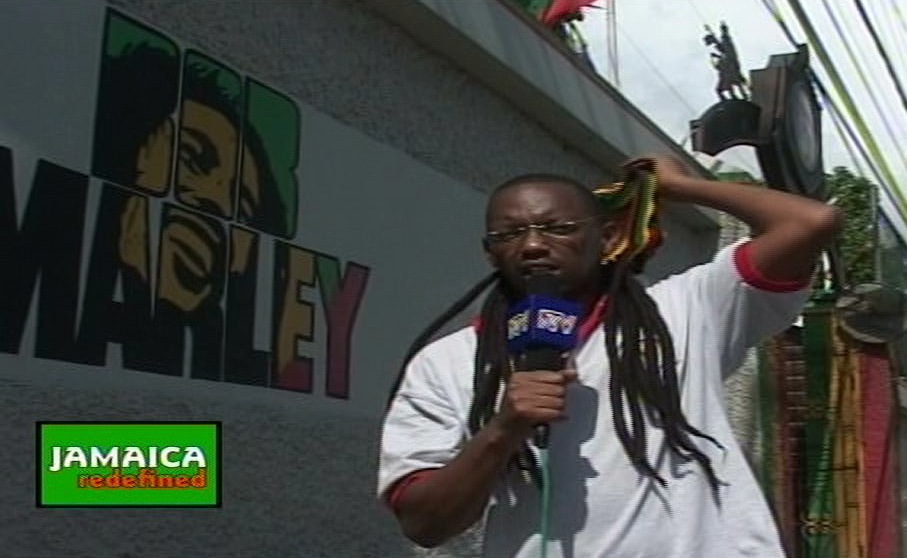
I'm still amazed that seven years down the line, I still encounter people, who recall a story I did, while on a news assignment in Kingston, Jamaica. And yes. The PTC is largely responsible for that.

However, there's got to be some sensible restraints.


The delivery of the PTC does not always warrant a soap-opera performance!


Tuesday, 19 August 2014

ENOUGH OF THE WELCOME BACK AND ON AIR GOODBYES!

It's pretentious and a stage-managed ploy to hoodwink the audience. One can even describe it as media personalities playing to the gallery. So you've been away for whatever reason, and when you reappear on TV screens, it's made to seem as if the public desperately needs an explanation of your absence. Enough of the welcome back and on air goodbyes! 


I can bet the proposed Standard Gauge Railway that TV news presenters and other journalists of a given broadcast station, have interacted or been in close contact, prior to going on air, even if one of them has been away from the office for some time.

So, when someone is introduced on air, the simulation of excitement at seeing each other is already an exaggeration. It should not be made overly dramatic, lest some soul out there is left with the impression that somebody is seeing his or her colleague for the first time on air, after their return to the newsroom.

And again, I plead, dear quasi-celebrity media personalities, spare us details that border on very personal information like who has procreated, (and no... this is not intended to be trash talk).


If 'Welcome back' pseudo-ceremonies are a visual nuisance and psychologically draining, then TV news broadcasts should not burden the audience with more 'Goodbye' festivities.

If one of the staff members is leaving, then the audience will eventually get a clue, if he or she ceases to appear on screen. There's nothing really special about changing jobs, to warrant excessive display of emotions on air.

It's also not exactly a complement to your employer, if you wish the departing colleague well, as he "moves to greener pastures!"

Enough of the welcome back and on air goodbyes!