If you feel a news story does not measure up to expected journalistic standards, bring it to the Journalism Dry Cleaner. Through our collective wisdom, we will strip it of all offensive dirt.

REAL TIME VISITORS

LIVE STATS

BLOG GUESTS

Friday, 9 August 2019

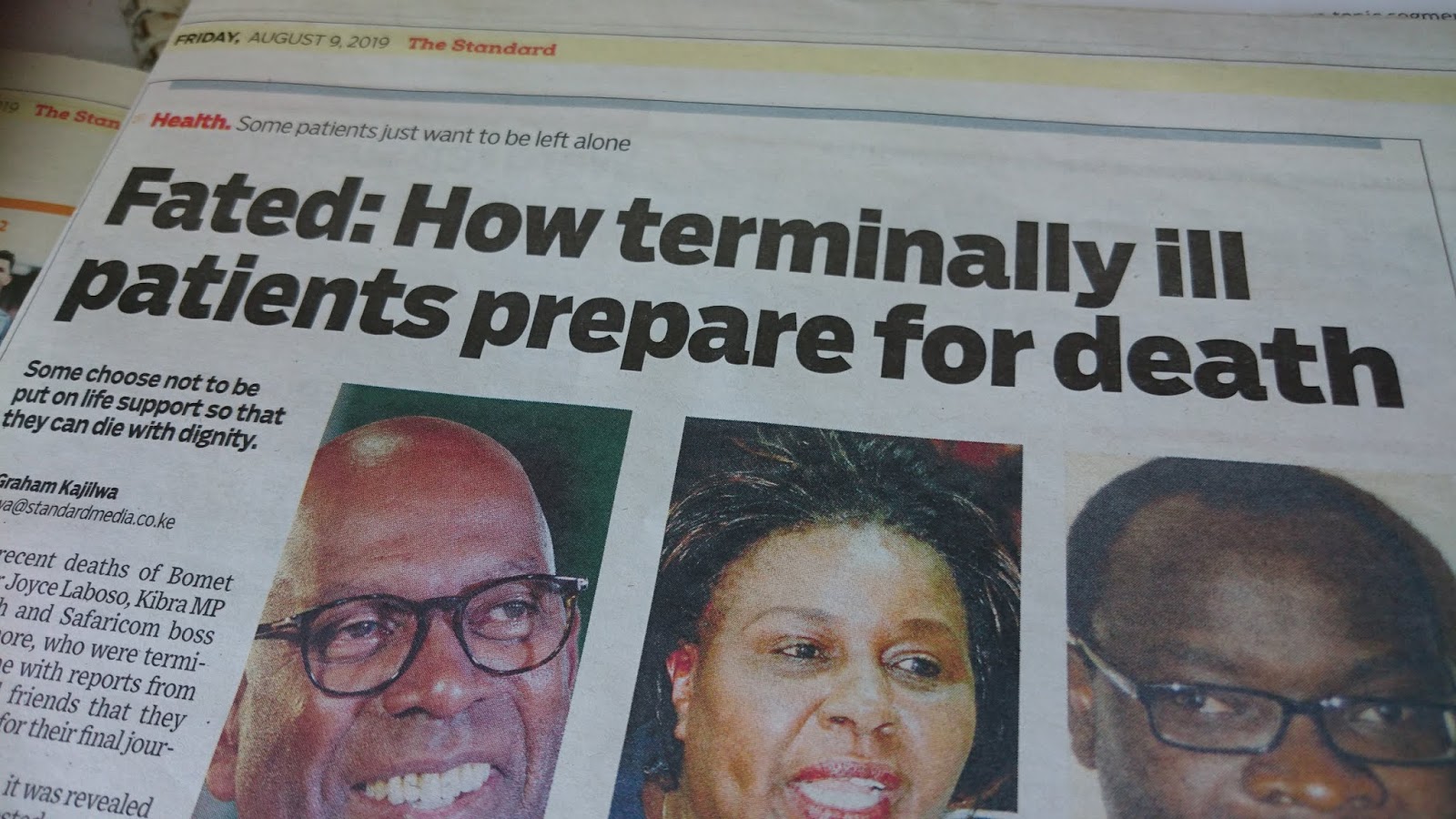
OF HEADLINES AND HEAD SPIN-INDUCING CONTENT

The language used by the press should communicate or convey information in a very direct and comprehensible manner. This means editors, reporters and writers must deliberately align their choice of words with the main aim of making it easy for the reader to understand a story. Sometimes though, one encounters headlines with head spin-inducing content. 


In the front-page teaser of a main article above, the paper deploys a rather confusing or, shall we say, unusual sentence construction.

It starts with:
'How fatally ill patients...'
That means patients who have already succumbed to their illness, no?

And if that be the case, then the second part of this headline gets eerily weird.
'....get set for death'.
Cue the head spin!

Fatal conveys a sense of finality or culminating in demise, or a not so pleasant fate.

So fatally ill patients, one would expect, are not in a position to do pretty much anything, because the illness has already resulted in fatality.


There are those on the verge of dying, that this newspaper story seeks to highlight their final moments and decisions.

This time around, the headline of the main article makes reference to, 'terminally ill patients', which gives room to suggest they can still do something, ahead of their sunset moment.


Thursday, 1 August 2019

HEALTH MEDIA COVERAGE AND THE MEDICAL DOCTOR PRESCRIPTION

Health matters have been getting massive attention in Kenyan media outlets. Many lives are being lost to major ailments, and even minor diseases. It's hardly debatable that health issues may not be a beat for any reporter. Specialised knowledge is key, but should it come from a journalism or medical school? And is a medical doctor the right prescription for newsrooms?


One channel has taken this bold step of engaging a qualified and experienced doctor, to spearhead its coverage of health-related news and programming.

Indeed, this needs to be acclaimed as a masterstroke, because the newsroom stands to benefit a great deal, by counting among its ranks, a doctor-cum media practitioner.

Similarly, the coverage of legal matters and court proceedings has arguably been improved by enlisting the services of lawyers, who are also keen on making a mark in the world of journalism.


But having a doctor, who comes highly qualified as a communicator as well, presents an interesting scenario.

- Can the good doctor be trusted to be neutral or balanced, when doing stories involving medical practitioners, like an industrial dispute?

- Will the public's interest be upheld, or will a 'Hippocratic' bias carry the day?

- And if the doctor is being interviewed, either as a panelist or a 'presenter's friend', should she be referred to as an 'Analyst' or 'Reporter'?


Probably the most significant issue, in my opinion, is the perception of the viewer.

Picture this:
A TV news story is about the shortage of doctors in Kenya, and how millions of lives could be in jeopardy, if the government does not address this lack of qualified medical personnel. 
Then the story ends with: Dr........reporting for........
Her journalism passion and reporting excellence notwithstanding, is the country being deprived of critical services of a very capable health professional?

Anybody can be a journalist, they've been saying.

It remains a calling, though.

And a doctor on call, might just be the right newsroom prescription.


Saturday, 27 July 2019

OF NEWSPAPERS MISQUOTING PHOTOGRAPHS

If facts are sacred, misquoting photographs should be sacrilegious. This may sound improbable because the media is more often accused of misquoting people and misinterpreting facts. Or publishing or broadcasting content out of context. But how else can one describe a newspaper that uses one photograph to show two different locations?


The two identical photographs above, appeared in one daily, but in separate pages.

The photo is first used to illustrate an article about plans to develop Isiolo Municipality, in central Kenya.


On turning the pages, one shortly encounters the same photo, (a much larger version).

But this time, the story is about the safety of flights to and from Kisumu airport, in the western part of the country.


What informed this editorial misadventure?

Both Isiolo and Kisumu counties have airports, so having a plane in the picture works for the two locations.

But not the same plane.

That's plain stupid!


Friday, 19 July 2019

SPORTS JOURNALISTS, FOOTBALL AND BECOMING ONE WITH ALCOHOL

What do you get from a sports journalist covering a football tournament in a foreign country? Articles about football, yes? And if the writer is enterprising, you expect coverage beyond football matters, no? The writer can focus on drinking habits, and the cost of beer in the host country. However, not only is it good not to mix drinks, it's bad for alcohol and football to become one.


Old habits die hard, and this perhaps explains the intrusion of the football field terminology, in an off-pitch scenario, in the side bar article, above.

The writer, one can hazard a guess, was sampling the social scene of the host country, and came dangerously close to the point where football and alcohol became one.

(Loosely translated to insinuate inebriation).

There's hardly any other colourful way to justify this statement:
'Beers in Nairobi go for between Sh200 and Sh350 defending on the brand and location.'
Well, it depends on whether one is being attacked by alcohol, or a competing team's attackers!

Friday, 12 July 2019

MEDIA MISMATCH, LOCAL NEWS AND CONTINENTAL TITLES

Influential people often get extensively featured in the media. Politicians definitely get more than their fair share of coverage. A number of such Kenyan leaders have multiple roles and attendant titles. Is it too much to ask that when captioning such personalities, their identities be put in the relevant context? Continental titles in a local news setup is clearly a mismatch.


It's all good to recognise important roles or status of newsmakers, and in the process, also help a viewer to appreciate why the views of the person appearing on TV are significant.

A Special Envoy of the African Union in a broadcast, is likely to add value and also help sustain attention in a news story.


But how is this even remotely related to...wait... not even a national matter...but a very local county governance issue?

The editorial competence on display here, I suspect, is suspect!


Friday, 5 July 2019

INTENDED ACTION HEADLINE AND AN UNINTENDED REACTION

A journalist or any writer must know that the interpretation of what's already published is likely to be beyond their control. As such, care should be taken to ensure any semblance of vagueness is dealt with, to narrow down the chances of misinterpretation. A headline can be loaded with many call to action words, but end up causing an unintended reaction.


The headline of the newspaper article above, can lead to a very 'dangerous' interpretation, which the writer and many a reader would be quick to frown upon.

What are people being urged to do?
"Embrace, encourage and support female genital cutting warriors"
Say that again slowly....but now with emphasis on the part that says:

'...female genital cutting warriors.'

What are we talking about here?

A warrior is a skilled fighter...so here...it can be somebody who is experienced in...female genital cutting?

Notice that it's not clear if the warrior is fighting against female genital cutting.

But, a warrior, in contemporary usage, can also be a reference to somebody engaged in a defined struggle or cause.

However, note again that the headline does not directly imply this warrior is against female genital cutting.

The constraints of space notwithstanding, the headline would have better communicated the message if it read:

"Embrace, encourage and support ANTI-female genital cutting warriors"

A good sub-editor should strive to panel beat the copy to make it as close to the intended meaning as possible.

Simply put, avoid being vague like the plague. And it's better to be obvious than ambiguous!

Friday, 28 June 2019

OF HEADLINES, TENSE EDITORS AND MIXING-UP TENSES

Media coverage can revolve around current issues, past events or even future occurrences. The reader, viewer or listener would not find it hard to follow a story framed on whichever time frame, especially if the context is logical. This is achievable as long as editors don't get tense, to the point of mixing-up tenses.

A news story can begin with the anticipation of a future happening, dash to past events, before settling on present issues.

This would still make sense, if the reporting tenses don't imply an element of time travel is required.

The date of writing this post is June 28th 2019.

This newspaper article was published on 26th June.

The story states the winner of the contest to replace Theresa May as UK prime minister will be announced on July 23rd.

But the headline states:
'New British PM named on July 23'
A reader has every reason to get tense, with this lack of attention to tense matters.

Or is this a prime example of a future, past impossible tense?

Cue in the tension headache!